Anew Market Dynamics provides research on advanced technologies, industrial markets and emerging commercial opportunities. Our studies combine market analysis, technology assessment, competitive intelligence and sustainability considerations to support informed business and investment decisions.
Anew Market Dynamics integrates market research, competitive intelligence, technology assessment and sustainability due diligence to provide a more complete understanding of evolving industries. Our studies examine market size and growth prospects together with the technologies, companies, regulation, investment conditions and environmental considerations that affect commercial adoption.
Defined market boundaries, segmentation, historical data and forecasts at global, regional and country level.
Company landscapes, product and technology positioning, partnerships, patents and investment activity.
Regulatory developments and commercially material environmental and social considerations, assessed alongside the market.
Defined scope. Documented assumptions. Research-led interpretation.
Competitive positioning, adoption conditions, geographical priorities and product planning.
Market entry, segment attractiveness, potential partners and investment conditions.
Commercial outlook, technology readiness, risks and material sustainability factors.
Independent sector evidence and research support for client engagements.
Policy, innovation and market conditions across technology sectors.
Licensing and supplying specialized research to their own clients.
Anew Market Dynamics delivers market intelligence and sustainability-focused research covering the technologies, industries and business models transforming the global economy.
Our research extends from established industrial markets to emerging technological frontiers, examining how innovation, investment, regulation, competition and sustainability priorities are reshaping markets worldwide.

Solar and wind, renewable integration, microgrids, energy storage, electric vehicles, sustainable aviation and maritime, and nuclear and fusion energy.

Next-generation manufacturing, automation and robotics, building materials, semiconductors, industrial biotechnology and advanced computing.

Digital health, extended reality, cybersecurity for energy systems, smart buildings, campuses and cities, and space technologies.

Carbon capture and accounting, advanced recycling, waste-to-energy, water treatment and sustainable packaging.

Precision and smart farming, agricultural AI, alternative proteins, medical technologies and advanced therapeutics.

Marine intelligence, environmental AI, green defense technologies and sustainable tourism.
ANMD studies combine market analysis with technology, competitive, regulatory and sustainability research. The scope and depth of each component are defined by the subject, the available evidence and the requirements of the individual study.
A small selection of recent studies. Each has a public table of contents and free sample pages.
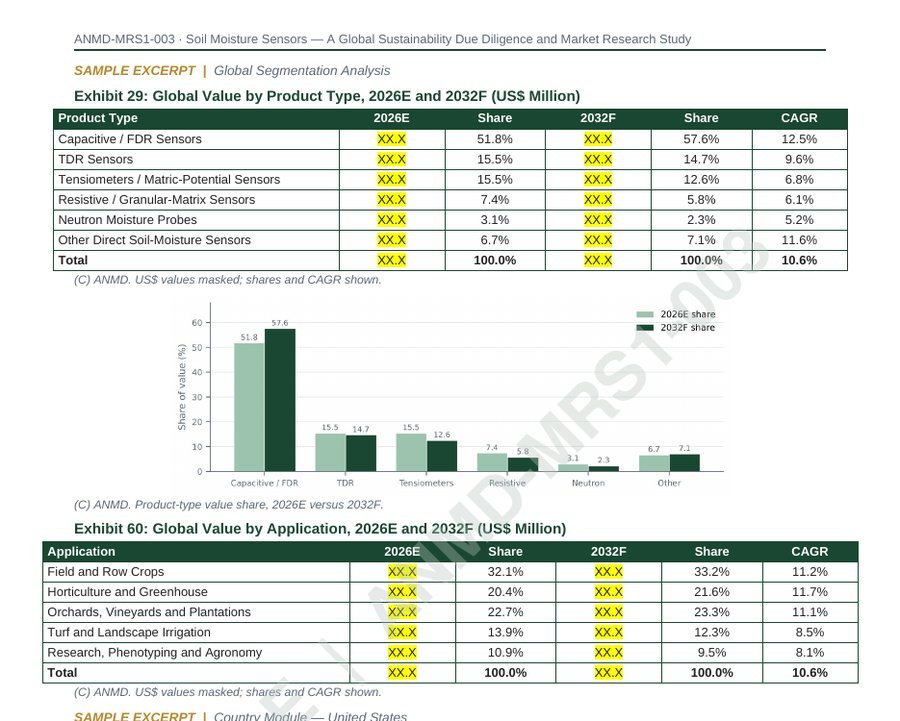
Each study is built around a defined market boundary and segmentation framework. Market tables report value, share and growth by segment, with charts showing how the market structure is expected to change over the forecast period. Studies typically include:
Shown: exhibits from the sample pages of Soil Moisture Sensors (ANMD-MRS1-003). Values are masked in sample pages; shares and growth rates are shown.
Defined markets, technologies, company landscapes, geography and policy conditions, examined within one study.
Clear scopes, documented modeling assumptions and review procedures before publication.
Environmental and regulatory considerations analyzed alongside conventional market research rather than in isolation.
Geographical analysis at the level each study's evidence supports.
Context for market entry, product planning, sourcing, strategy, due diligence and investment review.
Where a published study does not address your question, we scope and deliver a dedicated study: market sizing, technology assessment, competitor benchmarking or country analysis. Typical delivery is approximately 30 days from confirmation of scope, depending on complexity and data requirements.
Commentary from the ANMD research team, linked to the relevant studies.